
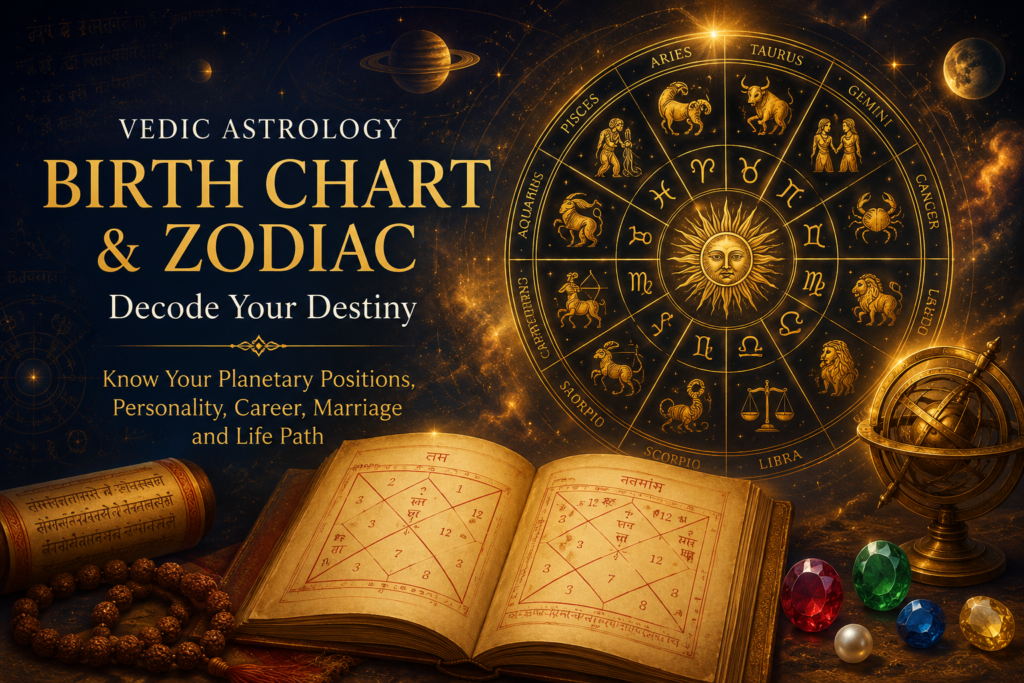
Have you ever wondered why two people born on the same day can have completely different personalities, careers, relationships, and life experiences?
In Vedic Astrology, one of the most important tools used to explore these differences is the birth chart, also known as a Janam Kundli.
A birth chart is a personalized astrological map created using the date, exact time, and place of birth. It shows the positions of the planets and other important astrological factors at the time of birth.
In this guide, we’ll explain what a birth chart is, what it contains, and how Vedic Astrology uses it to provide insights into different areas of life.
What Is a Birth Chart?
A birth chart is a snapshot of the sky at the exact moment a person was born.
In Vedic Astrology, the chart is calculated using:
- Date of birth
- Exact time of birth
- Place of birth
These details help determine the positions of the planets, zodiac signs, houses, and the Ascendant (Lagna).
Because the exact birth time can significantly affect the Ascendant and house placements, accurate birth information is important when preparing a personalized chart.
What Does a Vedic Birth Chart Show?
A Vedic birth chart contains several important components.
1. Ascendant or Lagna
The Ascendant is the zodiac sign rising on the eastern horizon at the time of birth.
It is one of the most important points in a Vedic birth chart and is used as the starting point for analyzing the twelve houses.
The Lagna can be considered an important reference point for understanding areas such as personality, physical characteristics, approach to life, and overall direction.
2. The Twelve Houses
A Vedic birth chart is divided into twelve houses.
Each house represents different areas of life.
For example:
1st House: Personality, self and overall life approach
2nd House: Wealth, family and speech
3rd House: Communication, courage and siblings
4th House: Home, comfort and mother
5th House: Education, creativity and children
6th House: Health, service and challenges
7th House: Marriage and partnerships
8th House: Transformation and shared resources
9th House: Higher learning, spirituality and fortune
10th House: Career, profession and reputation
11th House: Income, gains and social networks
12th House: Expenses, foreign connections and spiritual matters
The planets occupying these houses, as well as their relationships with other planets, are considered during chart interpretation.
The Role of Planets in a Birth Chart
Vedic Astrology traditionally works with nine major planetary influences, commonly called the Navagraha:
- Sun
- Moon
- Mars
- Mercury
- Jupiter
- Venus
- Saturn
- Rahu
- Ketu
Each planet is associated with different qualities and areas of life.
For example, the Sun is associated with authority and confidence, while the Moon is associated with emotions and the mind.
Jupiter is traditionally associated with wisdom and expansion, whereas Saturn is associated with discipline, responsibility and perseverance.
The meaning of a planet can change depending on its sign, house, strength, aspects and relationship with other planets.
Why Is the Exact Birth Time Important?
The exact birth time can be especially important because the Ascendant changes as the zodiac moves across the horizon.
Even a difference in birth time can sometimes change house placements and therefore affect the interpretation of a chart.
If the exact birth time is unknown, astrologers may use various traditional methods to estimate or rectify the birth time, depending on the circumstances.
What Is a Moon Sign?
The Moon sign, known traditionally as the Janma Rashi, is determined by the position of the Moon at the time of birth.
In Vedic Astrology, the Moon is given significant importance because it is traditionally associated with the mind, emotions, habits and mental tendencies.
This is one reason why simply knowing your Sun sign may not provide the complete picture according to Vedic Astrology.
What Are Nakshatras?
Vedic Astrology divides the zodiac into 27 Nakshatras, or lunar constellations.
The Moon’s position at birth determines a person’s birth Nakshatra.
Nakshatras are used in several areas of Vedic Astrology, including personality analysis and the calculation of planetary periods.
They can also play an important role in traditional marriage compatibility analysis.
What Are Planetary Periods or Dashas?
One of the distinctive features of Vedic Astrology is the use of Dashas, or planetary periods.
The Vimshottari Dasha system is one commonly used system.
It divides life into periods associated with different planets. Astrologers may examine these periods together with the birth chart and planetary transits when analyzing the timing of significant life events.
For example, an astrologer may consider the relevant Dasha and planetary transits when discussing career, marriage or financial developments.
Can a Birth Chart Predict Your Future?
Vedic Astrology is traditionally used to interpret tendencies, possibilities and periods of life rather than provide certainty about every future event.
A birth chart can be used to explore themes such as:
- Career and professional direction
- Marriage and relationships
- Financial tendencies
- Education
- Family matters
- Personal strengths and challenges
- Spiritual interests
- Major planetary periods
A professional consultation typically considers multiple factors instead of making conclusions from a single planet or zodiac sign.
Why a Personalized Birth Chart Reading Is Different
Generic horoscope content is usually based on broad zodiac categories.
A personalized birth chart reading is different because it considers your individual birth details and the specific planetary placements in your chart.
For example, two people may have the same Sun sign but different Ascendants, Moon signs, house placements and planetary combinations.
As a result, their charts can have very different interpretations.
Birth Chart and Gemstone Selection
In traditional Vedic Astrology, gemstones are sometimes recommended as astrological remedies based on an individual’s birth chart.
However, the same gemstone may not be suitable for everyone.
Gemstone recommendations can depend on factors such as the Ascendant, planetary strength, house ownership and overall chart configuration.
Therefore, rather than choosing a gemstone simply because it is associated with your zodiac sign, it can be more appropriate to have your birth chart analyzed first.
If you’re considering a gemstone for astrological purposes, a personalized consultation can help determine whether a particular gemstone is traditionally considered suitable for your chart.
How to Get Your Birth Chart Analyzed
For a personalized Vedic Astrology analysis, you generally need:
- Your date of birth
- Your exact birth time
- Your place of birth
An astrologer can then examine your Ascendant, planetary placements, houses, Nakshatra, Dashas and other relevant factors.
At Amit Astrology, personalized consultations can be used to explore areas such as career, marriage, birth-chart analysis and traditional astrological remedies.
Get Your Personalized Birth Chart Analysis
If you want to understand your birth chart beyond a general horoscope, consider getting a personalized Vedic Astrology consultation based on your birth details.
[Book a Vedic Astrology Consultation]
Frequently Asked Questions
Is a birth chart the same as a Kundli?
Yes. In the Indian/Vedic Astrology context, a birth chart is commonly referred to as a Janam Kundli or horoscope.
What information is needed to create a birth chart?
Your date, exact time and place of birth are generally required to calculate a personalized Vedic birth chart.
Can a birth chart help with career decisions?
Vedic Astrology traditionally examines various chart factors related to profession, work and financial matters. However, career decisions should also consider your skills, interests, education and real-world circumstances.
Can a birth chart help select a gemstone?
In traditional Vedic Astrology, gemstone recommendations may be based on the individual’s birth chart. It is generally better to evaluate the complete chart rather than choosing a gemstone solely based on a zodiac sign.
What if I don’t know my exact birth time?
An astrologer may sometimes use traditional birth-time rectification techniques, although the accuracy of any rectification depends on the available information and circumstances.